


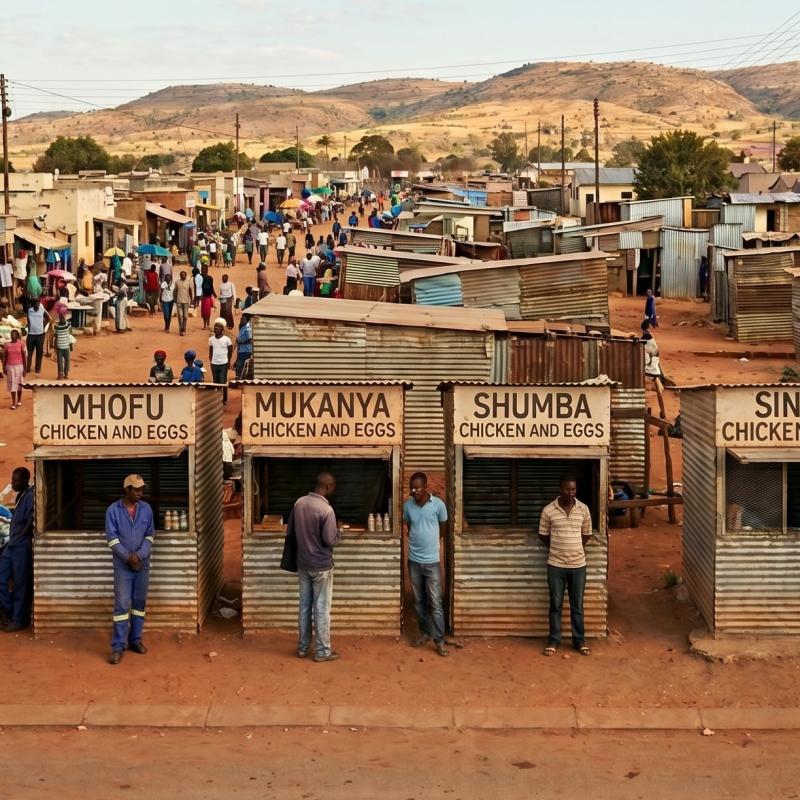
Why do small businesses in Southern Africa flock to the same trends? Explore the psychology of Copycat Capitalism and how to find opportunities in the gaps
Zimbabwe, and the broader Southern African region, is a landscape defined by economic waves that rise fast, crest furiously, and crash into oblivion just as quickly. Consider our recent history: the zvihuta (quail) craze, the potatoes-in-sacks rush, the saturation of the secondhand clothing market (bhero), and now, the sudden ubiquity of boutique fashion outlets and roadside solar equipment suppliers.
In standard economics, the first rule of business is simple: find a gap in the market and fill it. But in our local ecosystem, that logic is often inverted. The question driving investment is rarely, "What problem can I solve?" but rather, "What is giving quick returns right now that I can jump into?"
Africa is a continent ripe with genuine structural gaps. Tremendous opportunities exist across technology, cold-chain logistics, agro-processing, niche tourism, and leisure. Yet, our entrepreneurial impulse remains oddly hyper-localized and repetitive. If one neighbor becomes a "runner" cross-border sourcing goods, the entire street follows suit within a month. If one farmer hits a good payout on tomatoes, the next season sees a sea of red across the district. This behavior begs the question: Why do small business owners consistently manufacture their own rat-race to the bottom, oversupplying a single product until the market completely collapses under its own weight?
The Myth of the Accidental Entrepreneur
To understand the psychology behind these decisions, we have to interrogate the word "entrepreneur" itself. Many individuals operating small businesses today were forced into commerce by economic necessity rather than driven by an innate entrepreneurial spirit. True entrepreneurship requires a high tolerance for calculated risk, a willingness to venture into the unknown, and a desire to break boundaries—either by introducing entirely new products or adapting foreign concepts to solve local problems.
When economic volatility makes capital scarce, people cannot afford the luxury of a failed experiment.
With Copycat Capitalists, it is a completely different ballgame. This is not innovation; it is a survival mechanism. When economic volatility makes capital scarce, people cannot afford the luxury of a failed experiment. In this high-stakes environment, watching a neighbor successfully sell a product becomes a physical, undeniable proof of concept. Copying them feels like a shortcut to safety.
Where Does Originality Die?
We can trace this risk-aversion to two powerful forces: our education system and our social fabric. The traditional Southern African education system heavily rewards rote learning, strict adherence to instructions, and conformity over raw experimentation. When individuals transition into business, they subconsciously search for a "syllabus" to follow. Copying a dominant, highly visible trend becomes the corporate equivalent of studying the exam tips that worked for the top student last year.
In our tight-knit African communities, social proof carries far more weight than abstract market data. Stepping onto a unique, untested path feels lonely. Culturally, it also carries a much higher risk of visible, public failure. Replicating a neighbor’s business model provides a sense of community-validated security. It feels like a shared safety net—even when the cold economics of oversupply dictate that the net is about to rip.
Flipping the Script to Complementary Thinking
If we want to build resilient, wealth-generating businesses, we must challenge this collective blind spot. Instead of looking at a booming business and asking, "How do I copy that?" we must train ourselves to ask, "How do I serve that?" The real, sustainable money is rarely found in the trend itself, but in the infrastructure supporting it. Instead of building a chicken coop because your neighborhood is doing it, look at the supply chain. Who is providing the stock feeds, the automated feeding containers, or the temperature-control heating equipment? Instead of opening yet another tuckshop directly next door to an existing one, look at their operational headaches. What if you provided the B2B logistics and bulk-sourcing support to the fifty mushrooming shops in your community?
True commercial freedom in Africa will not come from fighting over a single, over-allocated slice of the pie. It will come from building the tools, the logistics, and the ingredients that help the entire bakery function. Moving away from the crowd is uncomfortable, but it is the only path that leads out of the survival trap and into genuine economic growth.